A motorized canoe crossing, haunting island legends, dramatic volcano views, and a guided trek into the Bwindi highlands—this is the new way to arrive.
If you are standing on the shores of Lake Mutanda at 7:00 AM, the first thing you’ll notice isn’t the scenery: it’s the cold. The mist rolls off the Virunga Volcanoes and settles over the water, and you will definitely need a fleece and a windbreaker before you even think about stepping into a canoe.
During a recent visit, I spent the day scouting a new route that links Kisoro town to the southern gates of Bwindi Impenetrable Forest. Most travelers sit in a 4×4 for three hours to make this journey, bouncing over dusty rocks and seeing nothing but the back of a driver’s head. We’ve decided there is a better way.
This Lake Mutanda canoe safari guide covers the operational realities of The Mutanda Crossing Experience, the local traditions we encountered in the swamps, and why you should care about a few small, silent islands with a dark history. If you are comparing routes into Bwindi lodge, this Lake Mutanda canoe safari is the one we use when you want stronger views and a more interesting transfer day.
What is The Mutanda Crossing Experience?
The standard transit from Kisoro to a Bwindi lodge in the Nkuringo sector is a grind. To fix this, we’ve mapped out The Mutanda Crossing Experience: a 4-hour Lake Mutanda canoe safari and walking route that gets you out of the car and onto the water.
Your day begins just outside Kisoro town. You won’t find a fancy pier here; you’ll step off a muddy bank into a traditional wooden dugout canoe. These boats are carved from single tree trunks, but for this crossing we use motorized canoes, not just paddles. Lake Mutanda is massive, with a larger surface area than Lake Bunyonyi, and we want to keep the crossing efficient without turning the lake section into an all-morning transfer. They are stable, but they sit low in the water. If you are worried about your camera gear getting wet from spray, bring a dry bag.
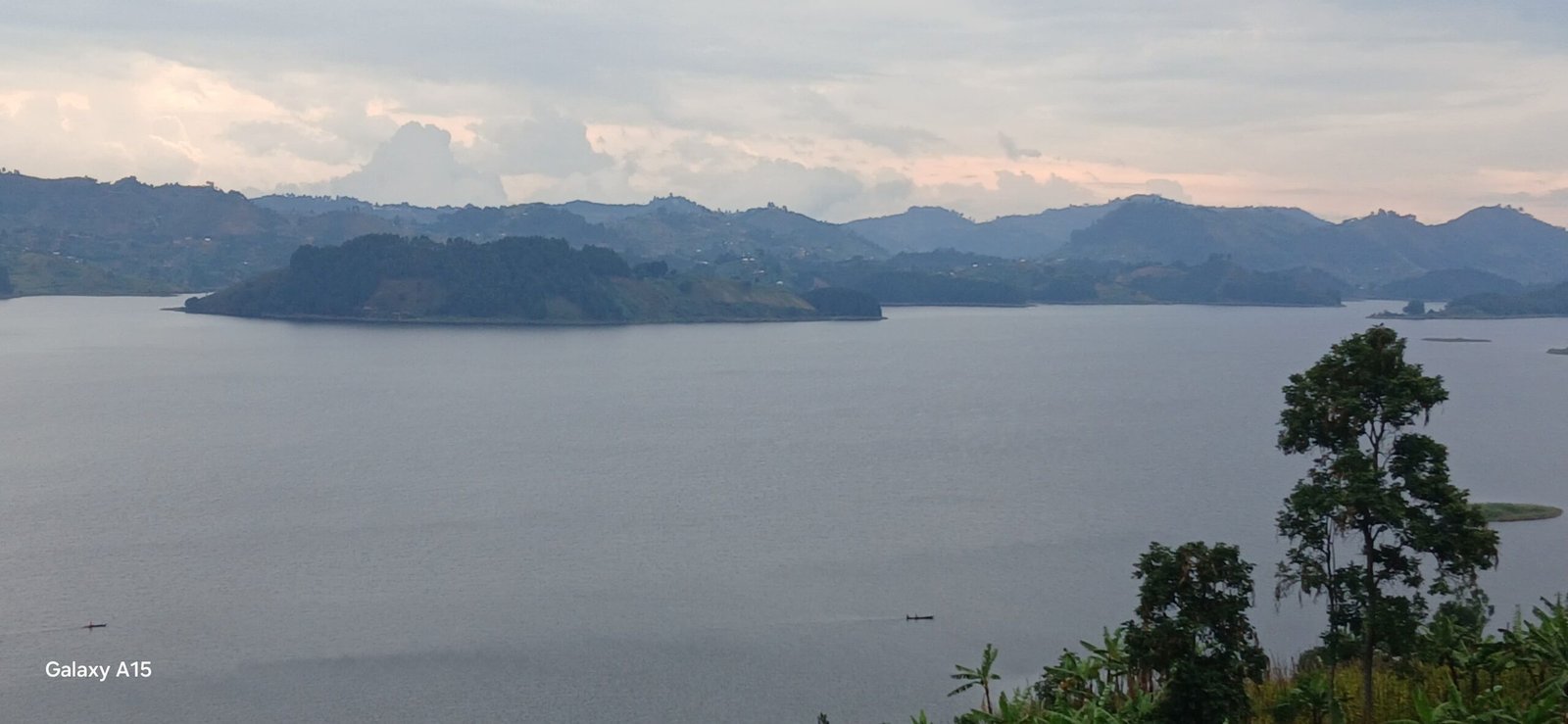
There are two routes from Kisoro to Nkuringo: the Lake Mulehe route, which is smoother, and the Lake Mutanda route. We prefer the Mutanda route because it is far more scenic. You have the Virunga volcanoes in the background for most of the crossing, plus clusters of small islands that break up the water and make the whole route feel less like transit and more like an actual safari.
You’ll spend roughly part of the 4-hour trip crossing Lake Mutanda before landing near the village of Rubuguli. To your left, the three main volcanoes: Muhabura, Gahinga, and Sabinyo: create a jagged skyline. The water is usually calm, but if the wind picks up, the crossing can get choppy. From there, the walking section starts.
The walk from Rubuguli to Nkuringo is where the landscape keeps changing. You start near the lake edge and swampy sections, then move through agricultural fields, patches of eucalyptus forest, and finally into the steep terraced landscapes that define the Bwindi highlands. You’ll gain several hundred meters in elevation. Your boots will get dusty, and your heart rate will stay high on the uphill sections. But when you finally crest the ridge and see the ancient green wall of Bwindi, you’ll understand why we recommend this over a car ride. It turns a boring transit day into a highlight of an adventure honeymoon Bwindi itinerary.
Why Lake Mutanda Has Some of Uganda’s Best Volcano Views
This is the main reason we keep recommending the Lake Mutanda route over Lake Mulehe if you want the stronger visual payoff. On a Lake Mutanda canoe safari, you get longer, cleaner views of Mount Muhabura, Gahinga, and Sabinyo without the route feeling boxed in. The volcanoes stay in view for much of the crossing, and the small islands scattered across the lake make the whole approach feel remote in a good way.
That sense of space matters. As you move toward Nkuringo, the route starts to make more sense as a transition into the Bwindi highlands rather than just a transfer. You leave the busier roads behind, move through lake communities and farming country, and arrive closer to the conservation landscape that defines Nkuringo. If you care about place, not just transport, this part of The Mutanda Crossing Experience is the real selling point.

Wildlife & Birdlife on Lake Mutanda
Lake Mutanda is not a classic big-game destination, so it helps to set expectations correctly. You are not coming here for lions or large herds. What you do get is a quieter, more local kind of wildlife watching. On a normal crossing, you can spot pied kingfishers hovering over the water, cormorants drying themselves near the shore, herons working the shallows, and weaver birds moving through the reeds.
You also spend time around local fishermen, and that adds another layer to the experience. They are not just working the lake; many of them are also the people who carry the oral history of the islands, the fishing grounds, and the older stories tied to this landscape. If you actually like hearing how a place works from the people who know it best, this section of the Lake Mutanda canoe safari delivers more than a simple scenic boat ride. For a wider bird conservation reference, BirdLife International is a useful authority on bird habitats and species: BirdLife International.
Why are kids fishing for mudfish in the swamps?
As we paddled through the papyrus reeds near the northern swamps during a recent visit, we ran into a group of local kids. They weren’t just playing; they were working.
In the shallow, muddy edges of the lake, mudfish, locally called ensonzi, are a staple protein. The fishing method is basic and effective. Instead of formal gear, local children often use old mosquito nets to scoop the fish from the muddy banks and swamp edges where they hide in the silt. It is messy work. They stand knee-deep in dark mud and papyrus runoff, dragging the nets through the shallows and checking for movement by hand.
If you are traveling with your family, we can arrange for your kids to join them. It is a blunt, hands-on lesson in how life works here. There are no “catch and release” ethics; if they catch fish, those fish are food or market stock. The local kids are also incredibly friendly, and you should definitely be ready to take some photos with them along the way. With the volcanoes behind them and the wetlands around them, this part of The Mutanda Crossing Experience feels very local and very real.
After the catch, the fish are commonly skewered on sticks and dried for sale in local markets. You will sometimes see women handling the trade side of it, selling bunches of dried ensonzi ready for cooking. It’s a raw look at culture in Uganda that you won’t see from the window of a luxury cruiser.
What happened on the Punishment Islands?
The History of Punishment Island on Lake Mutanda
Lake Mutanda has about 15 islands, but two of them carry a heavy silence. These are the Punishment Islands, known locally in connection with the Akampene tradition.
In older Bakiga culture, social rules around marriage, sexuality, and family honor were strict. If a girl became pregnant outside marriage, her family could see it as a disgrace and an economic loss, because bride price arrangements would likely collapse. In the harshest version of that punishment, she could be taken by boat to a small island and abandoned. That is the history most visitors now hear described as the story of Punishment Island on Lake Mutanda.
The name Akampene is often translated simply as Punishment Island. It refers to a real practice remembered in southwest Uganda, especially in stories passed down around the highland lakes. Because many people in the area did not know how to swim, being left on a rocky island was effectively a death sentence. Some women died of hunger or exposure. In other cases, a poor man who could not afford bride price would secretly paddle out and take the woman away to become his wife.
That history matters because it gives you a clearer view of Bakiga society beyond the postcard version. It shows how strongly family reputation, marriage negotiations, and community discipline shaped life in the highlands. It also explains why local guides still speak carefully when they point out these islands from the canoe.
Today, the islands are just clumps of trees and rock, but the local guides still speak of them with a certain level of unease. Oral histories around Lake Mutanda also include accounts of human remains being found on some of these islands, which is part of why the story still carries real weight locally and does not feel like folklore detached from the landscape. We don’t land on these islands, out of respect for the history, but we paddle close enough for you to see where these stories are anchored in the landscape. It’s a sobering reminder that Uganda traditions haven’t always been easy, and it is one reason this Lake Mutanda canoe safari feels more grounded than a standard boat ride.
How do you weave a basket from papyrus?
The edges of Lake Mutanda are thick with papyrus reeds. While they look like decorative plants to a tourist, they are a vital resource for the women in the nearby villages.
During our stop near Rubuguli, we watched a group of women harvesting the green stalks. They split the outer skin of the papyrus, dry it in the sun until it turns a pale beige, and then weave it into intricate baskets. This isn’t a performance for tourists; these baskets are used for everything from winnowing grain to storing beans.
Weaving is a slow, methodical process. It takes hours of repetitive finger movements to create a single small bowl. If you want to try it, be prepared for your fingers to ache. The women will show you how to start the base and how to create the geometric patterns using natural dyes made from local roots and leaves. Buying a basket here means the money goes directly to the weaver, bypassing the middlemen in the city gift shops.

Who Is This Experience For?
Before you book The Mutanda Crossing Experience, you need to be honest about your fitness level and travel style.
Perfect for:
- Gorilla trekkers traveling via Kisoro who want a better way to reach Nkuringo
- Guests with extra days at Orugano Bwindi Lodge
- Photographers who want volcano views, wetlands, village life, and terraced hills in one half-day activity
- Honeymooners who want a scenic transfer that does not feel generic
- Families who want a practical cultural activity, especially around the lake communities
Not ideal for:
- Travelers with serious mobility issues because the landing points and walking sections are uneven
- Anyone who strongly prefers staying in vehicles and avoiding mud, weather, or uphill walking
Is this trek right for you?
Here is the operational reality:
- The Duration: The full Lake Mutanda canoe safari and walking route takes about 4 hours in total.
- The Canoe: You will be sitting on a small wooden bench or the floor of the boat for part of the journey. We use motorized canoes to keep the lake crossing efficient, but they still sit low in the water. If you have back issues, let us know and we’ll bring extra cushions.
- The Weather: Lake Mutanda is at high altitude. If it rains, you will get wet. The dugout canoes have no roof. We provide rain ponchos, but the wind can still make it a cold experience.
- The Hike: The walk from the lake to Nkuringo is approximately 9 kilometers. It involves a steep ascent on dirt paths that can be slippery after a downpour. You need shoes with good grip.
- Permit Timing: If you are using this route to reach Bwindi for gorilla trekking the next day, we need to start early (around 8:00 AM) to ensure you reach your lodge before dark.
For those staying at the Orugano Bwindi Lodge, this route is the perfect “warm-up” for the physical demands of gorilla trekking. It gets your legs moving and helps you acclimatize to the thin mountain air.
How to Book & Logistics
The Mutanda Crossing Experience works best as a half-day activity either the day before or the day after gorilla trekking. You can book this Lake Mutanda canoe safari as a private excursion or have us build it into a tailor-made safari through southwest Uganda.
Route Map Graphic
Kisoro Town ➔ Lake Mutanda (Motorized Canoe) ➔ Punishment Island ➔ Rubuguli Landing ➔ Village Walk & Forests ➔ Nkuringo (Orugano Bwindi Lodge)
If you are already staying in Kisoro, we arrange your transfer to the launch point and coordinate the canoe crew and walking guide. If you are connecting this with gorilla trekking, we time the activity so you still arrive in Nkuringo with enough daylight to settle in properly.
What to Bring
- Fleece
- Rain jacket
- Camera
- Dry bag
- Hiking shoes
- Water bottle
- Sunscreen
Frequently Asked Questions
Is Lake Mutanda worth visiting?
Yes, especially if you want more than a roadside stop. Lake Mutanda gives you volcano views, island history, village life, birdlife, and a practical route into Nkuringo in one half-day experience.
Is the canoe ride safe?
Yes. We use motorized dugout canoes operated by local crews who know the lake well. The boats sit low in the water, so you should still pack carefully and listen to the guide during boarding and landing.
Can this be combined with gorilla trekking?
Yes. This is one of the main reasons we built The Mutanda Crossing Experience. It works well the day before or after gorilla trekking in Nkuringo and fits neatly into a wider tailor-made safari.
What is Punishment Island?
Punishment Island, often linked to the name Akampene, is one of the islands on Lake Mutanda tied to a hard part of Bakiga history. Local oral tradition says unmarried pregnant girls were abandoned there under older social rules, which is why the site still carries cultural weight today.
Photo Notes From Our Scouting Visit


Ready to explore the lake?
Lake Mutanda isn’t just a place to look at; it’s a place to move through. Whether you want to try your hand at mudfish fishing with the local kids or you want to challenge yourself with The Mutanda Crossing Experience, this Lake Mutanda canoe safari can fit neatly into your custom itinerary, especially if you want to connect local Uganda traditions with your stay at Bwindi lodge.
Send us your travel dates, and we will check the availability of our local canoe guides and walking scouts in real-time. If you’re planning a honeymoon, tell us, and we’ll make sure your landing at Rubuguli includes a private lunch overlooking the volcanoes.
All photos in this article were photographed by Orugano Bwindi during a scouting visit in June 2026.