- +256 701 230309
- info@oruganosafaris.com
- Nkuringo Sector, Kisoro, Uganda
- +256 701 230309
- info@oruganosafaris.com
- Nkuringo Sector, Kisoro, Uganda
Queen Elizabeth National Park (Uganda)

Tour Destination
Queen Elizabeth National Park (Uganda)
Queen Elizabeth National Park covers close to 2,000 square kilometres of western Uganda, in the Albertine Rift between the Rwenzori Mountains and the border with the Democratic Republic of Congo. Named after Queen Elizabeth II following her 1954 visit, it links Lakes Edward and George through the Kazinga Channel and holds savannah plains, crater lakes, forested gorges and wetlands inside one protected area. It is the park most visitors combine with the rest of a western Uganda itinerary.
Wildlife here is genuinely varied. Lions, leopards, elephants, buffalo, hippos and a long list of birds share the park with a set of experiences you cannot get in the same day anywhere else in Uganda: a game drive over the Kasenyi plains, a boat cruise along the Kazinga Channel and, in the far south, lions resting in fig trees.
One planning point shapes every good visit: the sectors are spread out and the road times inside the park are real. The park works best when you plan around the part you actually want to visit, rather than trying to reach all of it from one base. This guide explains the sectors, the six core activities, where to stay by area and how the park fits into a wider Uganda safari.
Wildlife Highlights
Wildlife sightings vary with season, weather and the day, and are never guaranteed. With that in mind, here is what the park is known for.
Lions and leopards. Lions are seen most often on the Kasenyi plains, where Uganda kob gather in large numbers, and leopards are present throughout the park, most often along the channel and crater areas. Sightings depend on the day and the skills of the guide tracking them.
Elephants, buffalo and antelope. Elephant herds move between the plains and the craters, buffalo gather in sizeable groups on the open grassland, and Uganda kob, waterbuck, bushbuck, warthog and giant forest hog are all regularly recorded.
Hippos and crocodiles on the channel. The Kazinga Channel carries one of the densest hippo populations in Africa, and Nile crocodiles bask along its banks. Both are best appreciated from the boat rather than at the waterside.
Birdlife. The park has recorded a high number of bird species, ranking it among Uganda's strongest birding destinations, with waterbirds along the channel, savannah species on the plains and forest birds in the gorges and Maramagambo Forest.
Kyambura chimpanzees. A small, isolated community of chimpanzees lives in the forested Kyambura Gorge, tracked on foot with a Uganda Wildlife Authority guide.
The Ishasha Sector and Its Tree-Climbing Lions
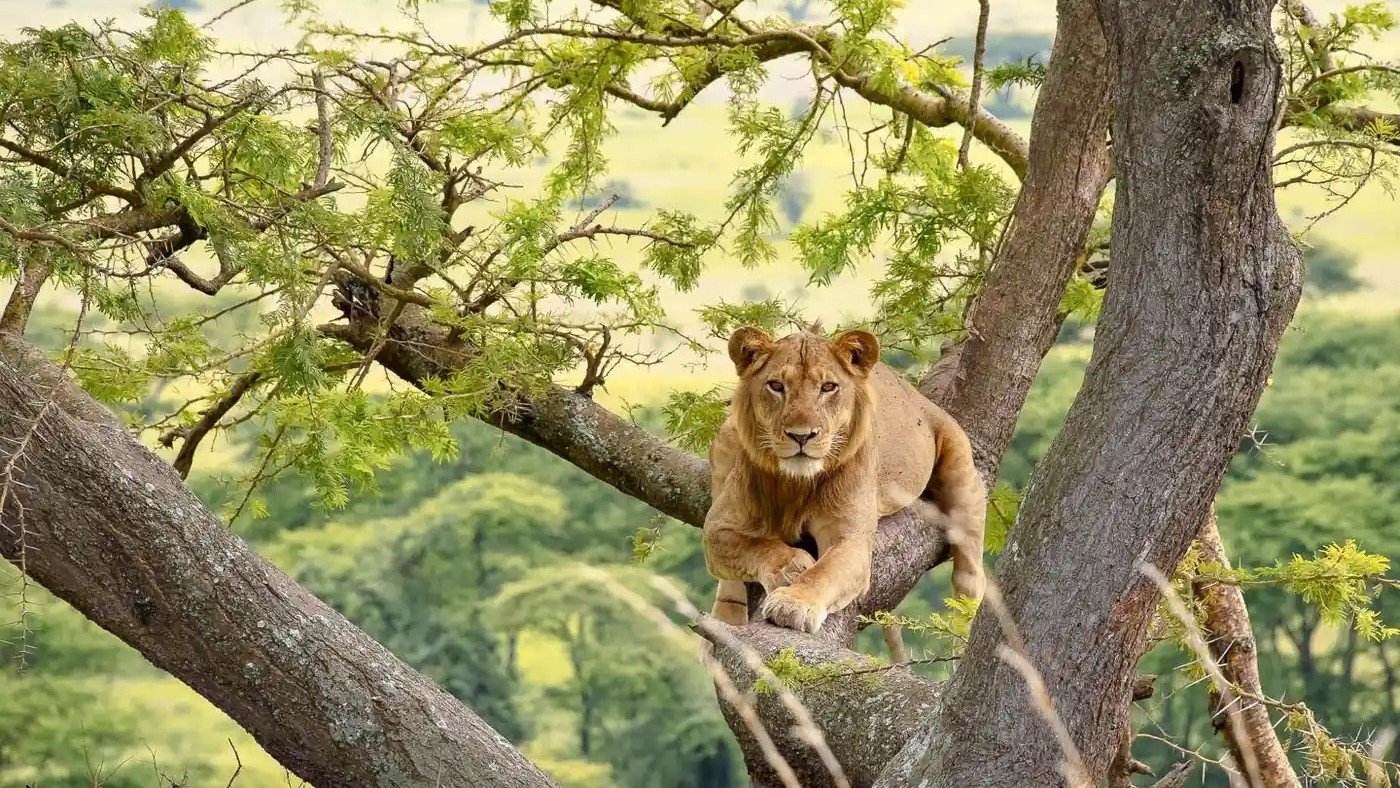
Ishasha is the southern sector of the park, reached by a different approach road from the Mweya and Kasenyi side. It is the part of Queen Elizabeth National Park that draws travellers for one specific reason: lions that climb and rest in the branches of large fig trees.
The behaviour itself is unusual. Lions here spend the heat of the day draped across fig tree branches, sometimes several metres off the ground. Why they do it is not fully explained. Possibilities include catching the breeze above the ground, avoiding biting insects in the grass, and having a raised vantage point over approaching prey. What matters for planning is that Ishasha is one of the few places in Africa where this is regularly observed, alongside a small number of sites elsewhere on the continent.
Practical planning points. A full day in the sector is the best way to give yourself a chance when tree-climbing lions are the priority. The lions move between fig trees, sometimes by several kilometres between morning and afternoon, and sightings are never guaranteed. Your driver-guide checks current sightings with the rangers on arrival at the sector, which is the single most useful thing a local guide does here.
Ishasha sits directly on the road between Bwindi Impenetrable National Park and the Mweya area, so it works as a stop on the crossing rather than a separate excursion. Guests crossing between Bwindi and the Mweya area can still enjoy a worthwhile game drive in Ishasha while travelling through, without setting aside a whole day. If tree-climbing lions are the reason for your visit, give the sector the time it deserves rather than squeezing it into a tight schedule.
The sector itself is quiet and open, with fig trees, acacia woodland and open grassland, and the general game viewing is good even on a day the lions are not in the trees. Uganda kob, topi, buffalo and elephants are all present.
Best Activities
Six activities make up the core of a visit. They suit different travellers and different lengths of stay, and the right mix depends on how many days you have and which sector you base yourself in.
Game drives on the Kasenyi plains
The Kasenyi plains, north of the Kazinga Channel, are the park's main game drive area. Open grassland makes wildlife easy to spot, and Uganda kob gather here in large numbers, which in turn draws the lions. Early morning is the most productive time for a game drive here, when predators are still active and the light is good. Orugano safaris include a licensed driver-guide for game drives. Access arrangements and the times game drives can run are set by the park, and we confirm the actual timing for your dates when we plan the itinerary. Kasenyi drives suit all travellers and work well for families with children, since the plains are accessible and wildlife viewing happens from the vehicle.
The Kazinga Channel boat cruise
The two-hour launch cruise along the Kazinga Channel is one of Uganda's strongest wildlife experiences. The boat drifts past hundreds of hippos, Nile crocodiles on the banks, buffalo coming down to drink and an extraordinary concentration of waterbirds, including pelicans, cormorants, fish eagles and, in season, migrating species. The cruise is guided and suits all ages and fitness levels, which makes it the easiest activity in the park for families and for older travellers. It runs from the Mweya area and needs no walking, so it is the one activity that every itinerary should include.
Ishasha tree-climbing lions
Covered in full in the section above. In short: a full day in the sector gives the best chance, though travellers crossing between Bwindi and Mweya can combine a game drive in Ishasha with the journey itself. Rely on your driver-guide to check current sightings with the rangers on arrival. The Ishasha section of this guide has the practical detail.
Kyambura Gorge chimpanzee tracking
The Kyambura Gorge is a forested canyon cutting through the savannah, and a small chimpanzee community lives inside it. Tracking runs as a guided walk with a Uganda Wildlife Authority ranger, down into the gorge and along the forest floor, and needs a permit booked in advance. The terrain is steeper than it looks from the rim, so a reasonable level of fitness helps. Chimpanzee sightings here are not guaranteed, as the community is small and moves through the forest. The gorge holds a smaller and more spread-out chimpanzee population than Kibale or Kalinzu, so the experience and the chances here are different from forest tracking in those areas. Kyambura suits guests already staying in the park; for the wider western Uganda route, Kalinzu Forest Reserve is our main chimpanzee tracking point and the option we recommend. The walk suits teenagers and adults rather than young children, and a morning is normally enough.
The Maramagambo Forest walk and bat cave
Maramagambo Forest, south of the channel, offers a guided forest walk through primary forest with monkeys, forest birds and a sequence of caves. The best known is the bat cave, where African rock pythons are sometimes seen in the trees at the cave mouth, feeding on the fruit bats that roost inside. This is a factual observation of the local food chain rather than a spectacle, and your guide will explain how it works. Cave access arrangements and any visitor restrictions are confirmed at the time of booking, because access can change. The walk needs a licensed guide, suits most fitness levels and takes a morning or an afternoon.
The crater lakes drive
A chain of volcanic crater lakes sits within and around the park, in the foothills of the Rwenzori. The drive between them is scenic and slow, with viewpoints over the lakes, birdlife along the shores and small communities living around the rims. It is a half-day activity that needs no walking beyond short viewpoint stops, so it suits all travellers including families. It combines naturally with a stay in the crater area rather than Mweya itself.
Park Entry, Permits and Activity Fees
Entry to Queen Elizabeth National Park is charged per person per day by the Uganda Wildlife Authority. The Kazinga Channel boat cruise and Kyambura Gorge chimpanzee tracking are separate activities, each with its own fee, and the chimpanzee tracking permit must be arranged in advance.
When you book a complete safari with Orugano Safaris, the park entry fees and activities included in your confirmed itinerary are incorporated into your quotation. We arrange the necessary permits and payments in advance wherever applicable, so you know what is covered before travelling.
Rates are set by the Uganda Wildlife Authority and change from time to time, so we confirm the current tariff with you when we prepare your quotation.
There are no gorilla permits here, because gorilla trekking takes place in Bwindi Impenetrable National Park and Mgahinga Gorilla National Park. If gorilla trekking is part of your plan, it is arranged separately from this park and, for information on how that works, see our gorilla trekking page.
Where to Stay Around Queen Elizabeth National Park
Accommodation around the park falls into four main areas, each with a different character and a different fit with your activity plan.
Mweya Peninsula and the channel. The base for the boat cruise and the Kasenyi game drives, with the widest choice of accommodation inside the park. It suits travellers who want the classic game viewing experience and the shortest access to the launch. Mweya Safari Lodge is one example of the property standard in this area.
The Ishasha sector. Remote, quiet and close to the fig trees, suited to travellers making the crossing towards Bwindi or giving the sector a full day for tree-climbing lions. Accommodation here is smaller and more spread out. Ishasha Wilderness Camp is one example of the property standard in this sector.
These properties are given as indicative examples of the standard and location available, not as confirmed accommodation. We check availability, suitability and current operating status when we plan your itinerary and confirm the actual properties in your quotation.
Around the Katunguru road and Kasese. A wider range of accommodation outside the park, often better value, and a practical base if your plan mixes Queen Elizabeth with Kibale to the north. It involves longer daily drives into the park.
The Kasenyi area. Close to the plains and to the kob breeding grounds, suited to travellers who want dawn game drives without the drive from the peninsula.
Accommodation is selected according to your travel dates, the number of travellers, your activity plan and your agreed accommodation category. We recommend specific properties when we plan your itinerary, based on current availability, and confirm them in your quotation.
Getting There and Getting Around
Typical planning estimates by road are: from Kampala to the Mweya area, roughly five to six hours; from the Kibale Forest area, roughly one and a half to two hours; from Bwindi via Ishasha, roughly two and a half to three hours to the southern gate, plus a further hour and a half to Mweya; and scheduled charter flights, which shorten the journey considerably and land close to the park.
These are planning estimates only. Road times in Uganda vary with roadworks, weather and traffic, and timings for your specific dates are confirmed with us when we plan your itinerary.
Getting around inside the park is by vehicle on game tracks. The Mweya area and Ishasha are far apart, connected by a long road through the middle of the park, so your base should be planned around which of the two matters more to you. Travellers who want both normally split the stay rather than commuting between sectors each day.
Best Months to Visit
June to August is the driest period, with the best game viewing conditions and the most reliable boat cruises on the channel.
December to February is a second dry season, with very good conditions and thinner vegetation that makes wildlife easier to spot.
March to May and October to November bring the rains, which make some game tracks more challenging but coincide with strong birding, including migratory species.
Rain can fall in any month, and wildlife sightings are never guaranteed regardless of the season. The dry seasons shift the odds in your favour; they do not remove the weather from the equation.
Altitude and Climate
The park spans roughly 910 to 1,390 metres above sea level, which keeps temperatures warm rather than hot, typically in the low thirties Celsius during the day and noticeably cooler after dark. The park straddles the equator, and a marker on the main road lets you stand in both hemispheres within a few paces.
Rain can fall in any month, heaviest in the two rainy seasons, and the equatorial sun is strong at midday. Mornings and evenings are the most comfortable times for game drives, which conveniently are also the best times for wildlife.
How Many Days Do You Need?
Two days, one night. Workable if you are already in western Uganda, usually arriving from Kibale. One game drive and the Kazinga Channel boat cruise. Not recommended if you are driving from Kampala, because the driving takes most of the time.
Three days, two nights. The practical minimum for most travellers. Allows two game drives on the Kasenyi plains and the boat cruise, with either Kyambura Gorge chimpanzee tracking or a crater lakes drive.
Four days, three nights. Adds a full day in Ishasha for tree-climbing lions, or a slower pace with time in both sectors. This is the option we recommend when Ishasha matters to you.
Longer. The park also works as a multi-night stop inside a longer Uganda safari, connecting to Kibale in the north or Bwindi in the south.
The right number of days depends on where you are arriving from and what you want to prioritise, and we advise on this when we plan your route.
How It Fits Your Itinerary
Queen Elizabeth National Park sits in the middle of Uganda's western circuit. It links naturally with Kibale to the north and Bwindi to the south, with Ishasha as the bridge on the Bwindi side. That position, more than any single attraction, is why it appears in so many Uganda itineraries.
Kalinzu Forest Reserve is our main chimpanzee tracking point for this part of Uganda and the option we recommend by name on the wider western Uganda circuit. It sits naturally on a Bwindi to Queen Elizabeth route, without travelling farther north to Kibale, while Kyambura Gorge remains the in-park option for guests already based in the park. See our Kalinzu Forest Reserve page for how it fits.
For travellers continuing south, the park connects directly with gorilla trekking in Bwindi via Ishasha, and with Kibale National Park to the north for chimpanzee trekking. For the longer northern circuit, Murchison Falls National Park combines well on itineraries of ten days or more.
Conservation Notes
Queen Elizabeth National Park is a corridor for wildlife movement between the Albertine Rift forests and the open savannah, and its connection to surrounding protected areas matters for the health of elephant and other wide-ranging populations.
Elephant numbers recovered over recent decades following heavy poaching pressure in the 1970s and 1980s, a recovery that reflects sustained protection and the work of the rangers who patrol the park.
Community revenue-sharing from park fees supports local projects around the park, connecting the value of conservation to the communities who live alongside it. Travelling with a local operator keeps that value in Uganda.
Packing Guidance
A practical list for this park:
- Neutral-coloured lightweight clothing for savannah game drives
- Sun hat and sunscreen
- Binoculars, for open-plain wildlife and birdlife on the channel
- Rain jacket, since rain can fall in any month
- Long sleeves and trousers for dawn and dusk drives, because of mosquitoes near the water
- A camera. Modern camera phones are sufficient for good photographs; a longer lens is optional
Frequently Asked Questions About Queen Elizabeth National Park
Are tree-climbing lions guaranteed? No. A full day in Ishasha gives the best chance, and your driver-guide will check the current sightings with the rangers on arrival. Sightings of any wildlife are never guaranteed.
Is the Kazinga Channel boat cruise worth it? Yes. It is one of Uganda's strongest wildlife experiences, suits all ages and fitness levels, and puts you close to hippos, crocodiles and birdlife along the channel.
Can I self-drive in Queen Elizabeth National Park? Self-drive visitors need a suitable 4WD vehicle and must follow current park access rules. Main tracks are generally passable in the dry season. We confirm current access and payment arrangements when we plan your trip; Orugano safaris include a private driver-guide.
Which part of the park should I stay in? It depends on your priority. Mweya suits the boat cruise and the main game drive areas, Ishasha suits tree-climbing lions and a Bwindi crossing, and the Kasese and Katunguru area offers a wider range of accommodation. We plan the base around your activities rather than the other way round.
Do I need a guide in Queen Elizabeth National Park? A licensed driver-guide is strongly recommended. Tracks are extensive, wildlife sightings depend on local knowledge, and conditions change with the season. We provide a private driver-guide on all our itineraries.
Planning Your Queen Elizabeth Safari with Orugano Safaris
We arrange private safaris to Queen Elizabeth National Park, combining game drives, the Kazinga Channel boat cruise and visits to Ishasha, Kyambura Gorge or the crater lakes according to your interests.
Our safaris use proper safari Land Cruisers and experienced driver-guides, with carefully selected midrange or premium accommodation. We also plan routes connecting Queen Elizabeth with Bwindi, Kibale and Kalinzu Forest Reserve, taking account of road conditions, travel time and your preferred activities.
Whether you are visiting for two nights or including the park in a longer Uganda safari, we can help you choose the most practical route and accommodation.
Uganda Safaris Including Queen Elizabeth National Park
These Orugano itineraries include Queen Elizabeth National Park:
- 8-Day Best of Uganda Safari
- 10-Day Western Uganda Safari
- 10-Day Gorilla Habituation, Kalinzu Chimps & Wildlife Safari
- 10-Day Uganda Safari from Kigali: Kibale, Queen Elizabeth & Bwindi
- 11-Day Uganda Gorilla and Primate Safari
- 12-Day Uganda Wildlife, Primate and Nature Safari
For the wider picture, browse our Uganda safaris page.
Plan Your Queen Elizabeth National Park Safari
Tell us your travel dates, the number of travellers and whether you prefer midrange or premium accommodation. We will recommend a suitable itinerary, including the best areas for game drives, the Kazinga Channel cruise and connections to Bwindi or Kibale. Plan Your Safari or request a custom quotation.